On Monday, a fair is built by hundreds of suppliers. On Tuesday thousands of visitors walk through the same halls. A week later, an international conference with VIP guests and separate access procedures will take place at the same location.
The location remains the same. The risks are constantly changing.
Dutch Crowd Security has been working at these locations for years and sees the difference between a regular object and an event location on a daily basis. Not only in the risks, but especially in what is required of security.
Why does an event location require a different security approach?
In the case of a regular object, the risk profile usually remains largely the same. Employees use fixed inputs, visitors log in and processes run according to known patterns. Of course situations can change, but daily surgery is often predictable. At an event location, that risk profile can change completely within a few days.
During the construction stand builders, technicians and suppliers are present. During the event, attention shifts to visitor flows, access control and monitoring. After completion, the location shall be safely transferred to phasing-out teams which remove materials, stands and equipment.
A security plan consisting solely of fixed control rounds or a security officer at the entrance is not enough here. Each phase requires different points of attention, other measures and sometimes other specialists. The same applies to access control. Visitors, exhibitors, suppliers, artists, technicians, speakers and VIP guests use different entrances and have different access rights. A supplier with access to the loading and unloading area does not need to have access to backstage areas. A visitor must not enter a technical space without supervision. Therefore, an event location requires a different approach to a regular object.
What are the risks we encounter in event locations?
During construction days, hundreds of external employees sometimes work simultaneously at a location. Suppliers drive off and on, equipment is brought in and various lots get temporary access to parts of the building. At this stage, there is regular uncertainty about access rights, powers and responsibilities.
At that time, large quantities of expensive materials, equipment and temporary installations are often on site. Without supervision, unnecessary risks arise for both the organisation and the suppliers concerned.
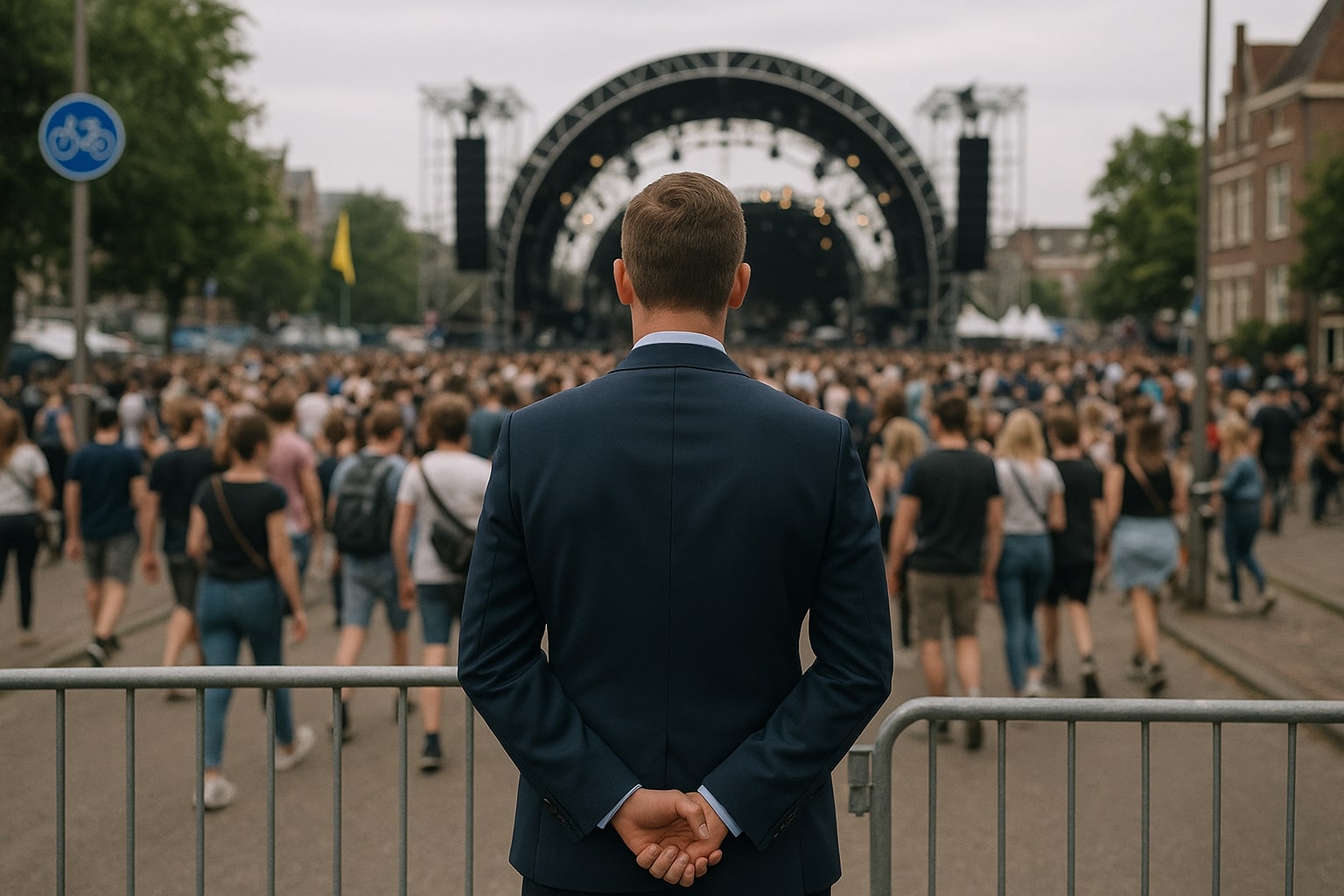
As soon as the event starts, attention shifts. Visitor flows must remain manageable. Emergency exits must be freely accessible. Unauthorized persons shall not have access to backstage areas, technical spaces or other protected areas of the site. A medical incident requires direct coordination between security, BHV organisation, location management and emergency services.
Afterwards a new situation arises. Visitors leave, suppliers return and valuable equipment is dismantled and removed. Each stage requires active monitoring. Anyone who doesn’t set that up in advance will notice at the wrong time.
Why is security mostly about directing?
At an event venue, dozens of parties often work together at the same time. Organisers, caterers, technicians, stand builders, facility staff, suppliers and security providers all have their own responsibilities.
Where many parties work together, uncertainty about responsibilities is a risk in itself. Who controls which entrance? Who’s in charge of an incident? Who decides who gets access to shielded spaces? Who is in contact with the organisation? If no one has answered those questions in advance, they will be answered at the moment of failure.
That’s why Dutch Crowd Security takes full control. The client has one contact point. We monitor the overall overview and ensure that all parties involved work according to the same agreements.
What role do fireguards and dog guides play in event locations?
At some locations and at certain stages, the deployment of security officers alone is not enough. Additional fire safety measures may be necessary during construction work, technical installations or work with increased fire risks. In those situations, we deploy state-qualified fire watch officers trained to identify risks early and act immediately when needed.
dog guides are also regularly deployed in event locations. Especially on large outdoor areas, parking spaces and construction areas, a dog guide provides extra visibility and a strong preventive effect. The combination of conductor and dog makes it possible to effectively control larger areas and gives a different type of presence than a security officer alone.
The use of fire watch officers and dog guides is always part of a broader security approach, tailored to the location, work and the risks involved.
When is extra security in an event location wise?
An ex ante risk analysis will clarify what measures are needed and where additional attention is needed. This creates a security approach that connects to the location, event and the risks present. Whoever brings security early into the process prevents surprises at times when there is no room to adjust.
Dutch Crowd Security secures event locations, fairs and business events throughout the Netherlands. You want to know your location? Contact us. We’ll think directly with you.